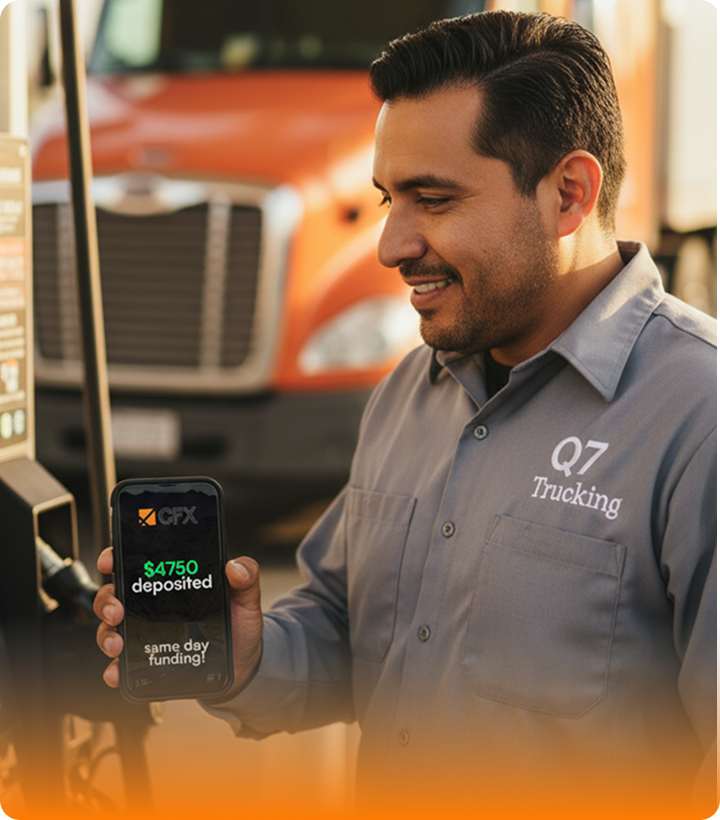
You hauled a flatbed load from Laredo to Dallas. The invoice was $4,200. You sent it to the broker on the 3rd. It is now the 18th of the following month, the broker's terms say net 45, and your fuel card, your trailer payment and your driver all needed money two weeks ago.
The load was profitable. The math worked. You still cannot pay for anything with it.
That gap between delivering freight and getting paid for it is what freight factoring exists to close.
Freight factoring, defined
Freight factoring is the sale of your unpaid freight invoice to a factoring company. You hand over the invoice and the paperwork, the factoring company pays you most of the invoice value within hours, and the factoring company collects from the broker or shipper on the normal terms.
It is a sale, not a loan. Nothing is owed back. You are not adding a payment to your books. You are selling an asset you already own, the receivable, at a discount in exchange for having the money now instead of in 45 days.
That distinction matters more than it sounds. A loan sits on your balance sheet and has to be serviced. A factored invoice is closed the moment the broker pays.
How freight factoring works, step by step
- You deliver the load. Nothing changes about how you run. You still book freight, run the miles, and get your BOL signed.
- You submit the invoice. Rate confirmation, signed BOL, and the invoice go to your factoring company, usually through an app or a portal. CFX carriers submit through the portal or the mobile app.
- The factoring company verifies the load. They confirm with the broker that the load was delivered and the invoice is valid. This step is why nobody can honestly promise a fixed funding time. A responsive broker verifies in minutes. A slow one takes a day.
- You get funded. The factoring company advances you the agreed percentage of the invoice. CFX advances up to 98% of invoice value, same day.
- The broker pays the factoring company. On their normal terms, 30, 45, 60 days, whatever the rate confirmation said. That wait is now somebody else's problem.
The first time you do this, there is onboarding paperwork and a Notice of Assignment that goes to your brokers telling them where to send payment. After that, it is submit and get paid, load after load.
What you take home depends on three numbers that interact, the factoring fee, the advance rate and the reserve, plus the per-transaction charges in the fine print. Our guide to freight factoring rates breaks down how they interact and what moves your rate, and the profit calculator will show you what a given rate does to your weekly take-home.
Recourse and non-recourse factoring
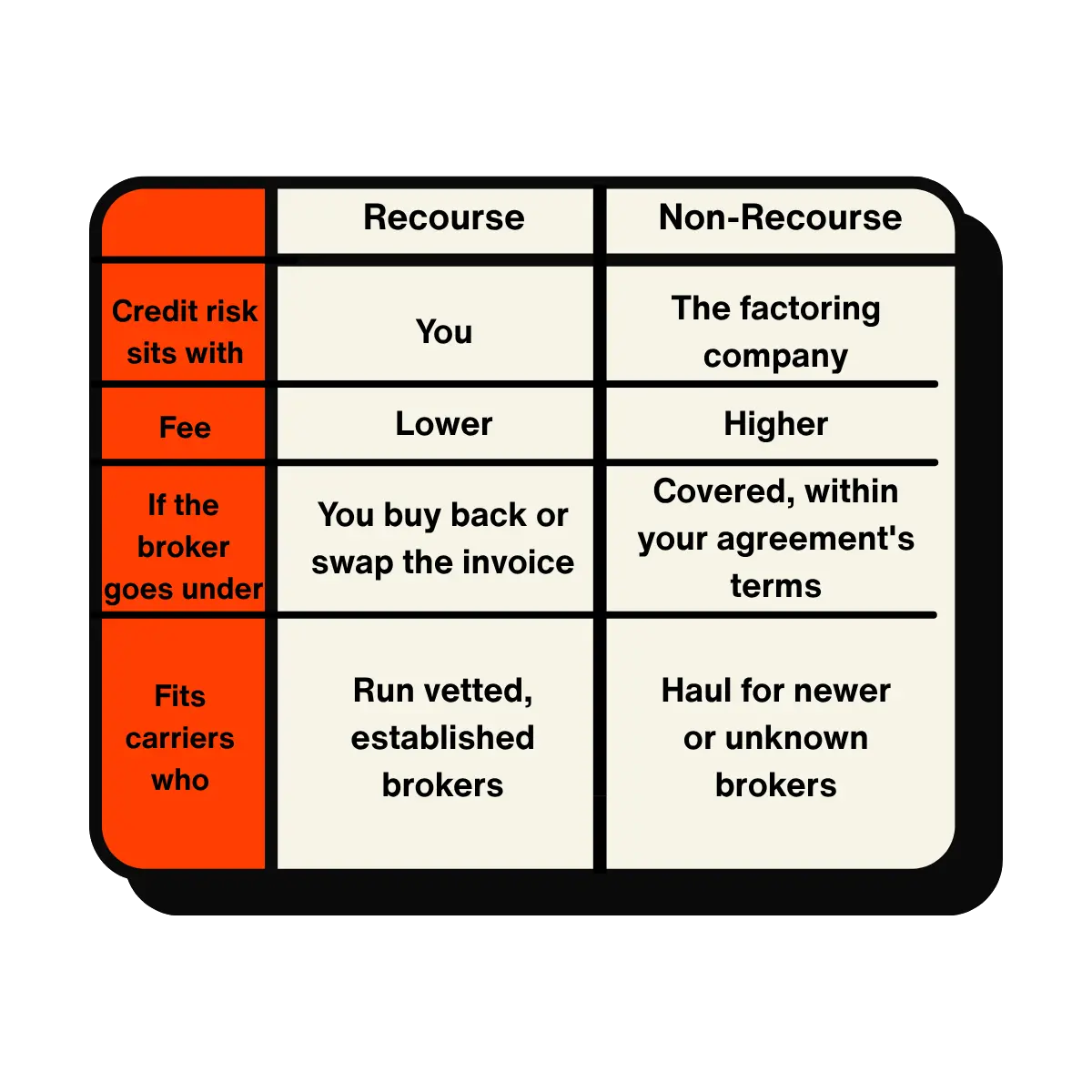
Every factoring agreement is one or the other, and the difference is about who absorbs the loss if the broker never pays.
| Recourse | Non-recourse | |
|---|---|---|
| Who takes the credit risk | You | The factoring company |
| Typical fee | Lower | Higher |
| If the broker goes under | You buy the invoice back | Covered, within the terms of your agreement |
| Best suited to | Carriers running vetted, established brokers | Carriers hauling for newer or unknown brokers |
Non-recourse is not blanket insurance. It covers the broker's credit failure, meaning they went out of business or became insolvent. It does not cover a dispute over a damaged load or paperwork you never submitted. Read what your agreement actually covers before assuming you are protected.
Longer comparison here: recourse vs non-recourse factoring.
Who freight factoring fits
Owner-operators
One truck, and every week is a cash flow decision. Fuel comes out of your pocket before the load pays, and one slow-paying broker can stop you running. Factoring turns your receivables into working capital without you having to sit on a line of credit or dip into savings between settlements.
Small fleets
At three to fifteen trucks, payroll is the constraint. Drivers get paid on a schedule that does not care when your brokers pay. Factoring lets you add a truck without first building up a cash reserve deep enough to float 45 days of operating costs on the new unit.
New authority
Under a year old and most banks will not talk to you. Factoring underwrites mostly your brokers' credit, which is why a carrier six weeks into operating authority can often factor when other funding is closed to them.
Carriers with a broker problem
If a meaningful share of your revenue sits with brokers you cannot fully vet, the credit checking that comes with factoring is worth as much as the funding. Knowing not to haul for someone before you haul for them saves more than a good rate does.
When factoring does not make sense
It is worth saying plainly, because most factoring content will not.
If you already have the cash to float 45 days comfortably, factoring costs you margin you do not need to spend. Carriers with strong reserves and reliable direct shippers often do better invoicing directly.
If you haul almost exclusively for one or two shippers who pay on time, the wait is predictable and the fee may not buy you anything.
If your margin is already thin on a given lane, the fee can be the difference between a profitable load and a break-even one. Run the numbers on that lane before you commit.
Factoring buys you time. Time is worth paying for when you do not have it, and worth nothing when you do.
How to compare factoring companies
Ask every company on your list the same questions, and get the answers in writing before you sign.
- What is the all-in cost, fee plus advance rate plus every per-transaction charge? A quote that does not include wire and ACH fees is not a quote.
- What is the contract term, and what does it cost to leave? Some agreements lock you in for a year with a termination penalty. Ask about the Letter of Release process before you need one, not after.
- Is there a monthly minimum volume? If you run seasonal, a minimum you miss in February is a fee you pay for nothing.
- Who do I actually call when something goes wrong? A named person who knows your fleet, or a general queue.
- What are your support hours? Freight does not stop at 5pm Friday. Ask what happens when you need something on a Saturday.
- Do you charge for fuel advances, and how much?
- How do you handle a broker who disputes an invoice?
The answers to the contract and support questions tell you more about the next two years than the rate does.
Frequently asked questions
Is freight factoring a loan?
No. Factoring is the sale of an invoice you already own. Nothing is owed back and no debt is created on your books. The factoring company collects from the broker, not from you.
How fast do you actually get paid?
Same-day funding is standard in the industry once the load is verified. Verification depends on your broker responding, which is outside any factoring company's control, so treat any promise of a guaranteed fixed time with suspicion.
What is a good advance rate?
Advance rates vary by carrier profile and broker mix. What matters is comparing the advance rate and the fee together, since a low fee with a low advance rate can leave you with less cash than a higher fee with a 98% advance.
Do you need good personal credit to factor?
Factoring decisions are based primarily on the creditworthiness of the brokers and shippers you haul for, since they are the ones paying the invoice. This is why new authorities can often factor when other funding is not available to them.
Can you factor with one truck?
Yes. Owner-operators are a core part of who factoring is built for.
What happens if the broker never pays?
On a recourse agreement, you buy the invoice back or replace it. On a non-recourse agreement, the factoring company absorbs a broker credit failure within the terms of your specific agreement. Read those terms closely.
Can you switch factoring companies?
Yes. Your current company issues a Letter of Release that cancels the Notice of Assignment so a new company can take over. Check your contract for notice periods and termination fees first.
Do brokers care that you factor?
Most brokers work with factored carriers every day and have processes for it. A Notice of Assignment is routine paperwork, not a red flag.
Getting started
If you are waiting 30, 45 or 60 days to get paid on loads you have already delivered, the question is not whether the wait costs you anything. It is whether it costs you more than the fee does.
Run your own numbers with the profit calculator first. Then, if you want someone to walk through your specific broker mix and lane profile, Talk to an Expert.