
If the numbers look good on paper but your bank account tells a different story, you're not alone — and it's not bad luck.
You're running 5 trucks. Each one is pulling $6,000 a week. That's $30,000 a week gross. $120,000 a month.
So why does your bank account look like you're barely getting by?
You're not bad at trucking. You might actually be really good at it. The problem isn't the miles, the loads, or the rates.
The problem is the system you're using to manage the money.
And until you fix that, it doesn't matter how many trucks you add. You'll keep making more revenue and somehow taking home less.
1. The Math That Doesn't Add Up
Let's put real numbers on paper.
5 trucks × $6,000/week = $30,000 gross per week.
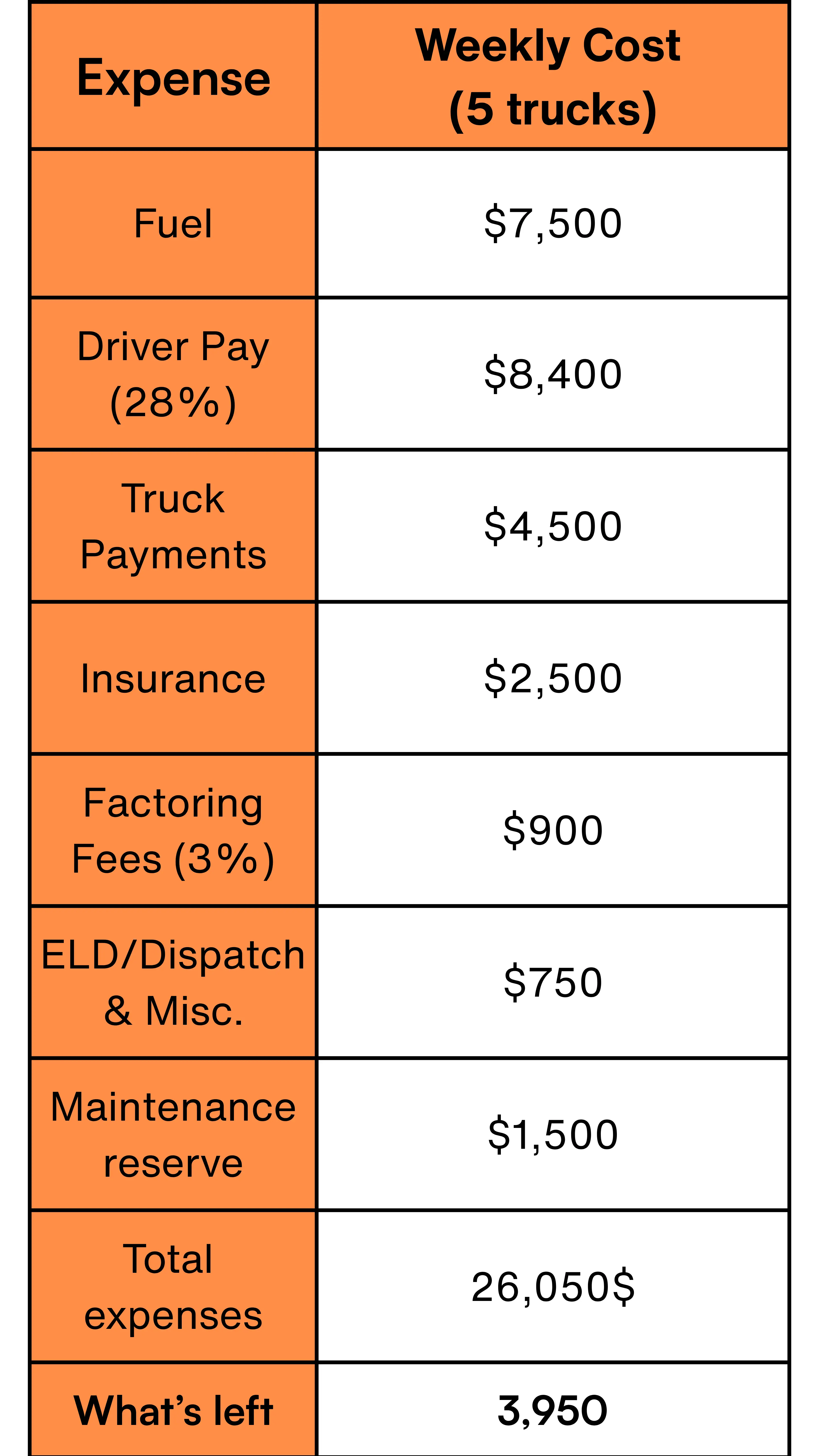
A quick review of the average expenses
Here's where that $30,000 goes before it ever hits your pocket:
And that $3,950 isn't even yours yet. That's before taxes, before unexpected repairs, before a broker shorts you on a load, before a truck sits for two days waiting on parts.
By the time everything shakes out, that $1,000 in your pocket starts making a lot more sense — and a lot less sense at the same time.
2. Where the Money Actually Goes
Most carriers focus on the big expenses — fuel, drivers, payments. Those are real. But the money that silently bleeds out of a trucking operation usually isn't one big thing. It's ten small things nobody told you to watch.
Fuel inefficiency: The difference between a driver who idles 3 hours a night and one who idles 30 minutes is about $150/week per truck. Across 5 trucks, that's $750 a week you're burning while parked.
Deadhead miles: Every empty mile is a mile you paid for and got nothing back. If your average deadhead is 15% of total miles, you're effectively giving away $4,500 a week in revenue capacity across your fleet.
Broker shorts and slow pays: Not every broker pays what they owe on time — or in full. Detention charges that don't get collected, lumper fees that get swallowed, accessorials that never make it onto the invoice. These add up to hundreds per truck per week for carriers who aren't tracking them.
Maintenance that gets deferred: A $400 repair today becomes a $2,800 repair in six weeks. Most small fleets defer maintenance because cash is tight — which makes cash tighter, which means more deferring. It's a cycle that kills equipment and eats profits at the same time.
The wrong factoring deal: This one deserves its own section.
3. The Cash Flow Trap Nobody Warns You About
Here's something most people don't tell you when you're getting started: the faster you grow, the worse your cash flow gets — if you don't have the right infrastructure.
Think about it. You add a truck. Now you have more invoices to wait on. More fuel to front. More driver pay going out before the money comes in. More insurance. More everything.
Revenue goes up. But the gap between money going out and money coming in gets wider.
This is the cash flow trap. And it's the single biggest reason small fleets stall out.
Brokers pay on 30, 45, sometimes 60-day terms. Your expenses hit daily. That gap — between when you deliver the load and when you actually get paid — is where most carriers quietly bleed out.
Factoring was supposed to fix this. For a lot of carriers, it creates a different set of problems.
4. Why You're Stuck at 5 Trucks
You've probably thought about adding a 6th truck. Maybe you've even run the numbers. $6,000 more a week in revenue. How could that not work?
Here's why it doesn't — at least not yet.
You don't have a cash flow buffer: Adding a truck means fronting more fuel, more insurance, more driver pay — before that truck generates a single dollar of collected revenue. If your current operation is running tight, a 6th truck doesn't solve the problem. It amplifies it.
Your cost per truck is too high: At 5 trucks, you're still paying retail on almost everything — insurance, fuel, maintenance. At 10 trucks, your negotiating position changes. But you can't get to 10 until you tighten the margin on 5.
You're losing money on the back end: Missed accessorials, uncollected detention, factoring fees you didn't negotiate, wire fees eating into every advance. None of these feel big individually. Together they're the reason the 6th truck never pencils out.
Your factoring company isn't built for growth: If your factor has slow funding, weekend cut-offs, hidden fees, or no fuel card program — they're costing you more than their percentage. They're costing you momentum.
5. The Factoring Fee Problem
Let's talk about the fee that most carriers underestimate.
A 3% factoring fee sounds small. And on a single load, it is. But run the math across a fleet and a full year:
$30,000/week × 3% = $900/week in factoring fees $900 × 52 weeks = $46,800/year
That's nearly $47,000 a year going to your factoring company. And that's before you add:
- Wire fees — $15 to $40 every time you want same-day access to your own money
- ACH fees — sometimes charged per transaction
- Monthly minimums — fees you pay even on slow weeks when volume is down
- Termination fees — sometimes thousands of dollars if you try to leave early
- Misdirected payment fees — charged when a broker accidentally pays you instead of the factor
- Duplicate invoice fees — charged when paperwork gets submitted twice, even by mistake
- Non-sufficient funds fees — if a chargeback hits and your reserve is low
A 3% rate with $40 wire fees, a monthly minimum, and a termination clause is not a 3% deal. It's significantly more expensive — and the difference comes directly out of that $3,950 that was supposed to be yours.
6. How to Actually Fix It
Here's the straightforward version.
Step 1 — Know your real cost per mile: Not your estimated cost. Your actual cost, including every fee, every empty mile, every idle hour. Most carriers who do this for the first time find they're $0.08 to $0.15 per mile off from what they thought. On a 5-truck fleet running 10,000 miles a week, that's $4,000 to $7,500 a week in unaccounted costs. Feel free to use our Cost Per Mile Calculator to calculate your CPM.
Step 2 — Audit your factoring agreement: Pull out your contract. Read every fee. Calculate what you actually paid your factor last month — not just the percentage, but every line item. Most carriers who do this are surprised by the number.
Step 3 — Fix your funding speed: If you wait on wires, pay for same-day access, or hold cash over the weekend, you lose money each week. Instant funding — real instant funding, available 24/7 — isn't a luxury at this stage. It's infrastructure. CFX partners with TANK Payments to fund invoices in seconds, any time of day, any day of the week. No wire fees and no cut-off times.
Step 4 — Stop paying for fuel at full price: A fuel card with real discounts — not a card that just tracks spending — can save $0.40 to $0.70 per gallon. Across 5 trucks burning 600 gallons a week each, that's $1,500 to $2,100 a week back in your pocket. That's $78,000 to $109,000 a year. The CFX fuel card averages $0.47 per gallon in savings at over 1,100 locations nationwide.
Step 5 — Track every accessorial Detention, layover, TONU, lumper reimbursement — collect all of it, every time. Build a system. Most small fleets leave $500 to $1,500 a week on the table here simply because nobody is tracking it.
Step 6 — Then add the 6th truck Once your cost per mile is accurate, your factoring is clean, your funding is instant, and your fuel costs are under control — now the 6th truck makes sense. Because now you're adding revenue on top of a solid foundation instead of adding stress on top of a leaky one.
7. FAQs
Why am I grossing $6,000 per truck but only taking home $1,000? Because trucking has high fixed and variable costs that hit before revenue is collected. Fuel, driver pay, insurance, truck payments, and factoring fees typically consume 80–90% of gross revenue. The remaining margin is thin — and shrinks further when cash flow is mismanaged, fees are hidden, or funding is slow.
What is a good profit margin per truck in trucking? A healthy owner-operator or small fleet should aim for 15–25% net margin after all expenses. Most carriers running under 10 trucks operate closer to 8–12% before optimizing their cost structure. Getting to 15%+ requires tight fuel management, clean factoring, and consistent accessorial collection.
How do factoring fees affect my take-home pay? More than most carriers realize. A 3% factoring fee on $30,000/week is $900/week — $46,800/year. Add wire fees, monthly minimums, and other charges and the real cost climbs significantly. Choosing a transparent factoring partner with no hidden fees and instant funding directly increases your take-home.
Why can't I scale past 5 trucks? The most common reasons are a low cash flow buffer, a high cost per truck, untracked expenses, and factoring that doesn’t support growth. Scaling requires fixing the margin on existing trucks before adding more — otherwise you're multiplying the problem, not the profit.
What is the biggest hidden cost in trucking? Fuel inefficiency and factoring fees are the most common, but the biggest single hidden cost is usually the gap between when money goes out and when it comes in — the cash flow lag. The wider that gap, the more it costs you in missed opportunities, deferred maintenance, and stress-driven decisions.
How does instant funding help small fleets grow? When your money arrives in seconds instead of days, you stop making decisions based on what you're waiting on and start making them based on what you actually have. That shift — from reactive to proactive cash management — is what allows a 5-truck fleet to operate with the confidence of a 10-truck fleet.
Is CFX the right factoring partner for a growing fleet? CFX is built specifically for carriers who are serious about growth — instant funding through TANK Payments, a fuel card averaging $0.47/gallon in savings, transparent fee structures, and no hidden charges. If your current factor is costing you more than their percentage, it's worth having the conversation.
Ready to stop leaving money on the table? Talk to CFX today and find out what your factoring deal is actually costing you.