91.5% of U.S. carriers run 10 trucks or fewer. These regulations hit them hardest — and most don't find out until it's already costing them money.
You're running 5 trucks. You're the owner, the dispatcher, the HR department, and the compliance officer — all at the same time. And each time a new regulation comes out, you have to figure out how to handle it. You must do it without missing a load or blowing your budget.
Large carriers have entire departments for this. You have yourself, maybe a part-time office person, and whatever you can Google at 10 PM after everyone else has gone home.
That's the reality of running a small trucking fleet in 2025. And if you are not keeping up with new regulatory changes, fines, failed inspections, and higher insurance rates will hit you first.
Here's everything you need to know.
1. Why Small Fleets Get Hit Harder Than Large Carriers
The U.S. Department of Transportation reported 3.58 million truck drivers employed in 2024. Of all active U.S. motor carriers, 91.5% operate 10 trucks or fewer. That's the overwhelming majority of this industry — and they're the ones who feel every regulatory change most directly.
Large carriers have compliance teams, legal counsel, and the budget to absorb new costs without flinching. When a new ELD mandate drops or emissions standards tighten, they update a system and move on.
Small fleets don't have that cushion. Every new compliance requirement means one of two things: you figure it out yourself, or you pay someone to figure it out for you. Either way, it comes out of the same thin margin you're already stretching across fuel, insurance, and truck payments.
The regulations aren't going away. The freight isn't slowing down — trucks moved 72.7% of the nation's freight by weight in 2024, according to the American Trucking Association. The only variable you can actually control is how prepared you are.
2. ELD Requirements and Digital Compliance in 2025
Electronic logging devices are not new. But rules around them keep changing. Small fleets are still catching up.
ELDs automatically record driving time, engine hours, vehicle movement, miles driven, and location data. They replaced paper logs and made HOS enforcement significantly more consistent. If you're running a truck that requires an ELD and you don't have one installed and functioning correctly, you're not just risking a fine — you're risking an out-of-service order on the spot.
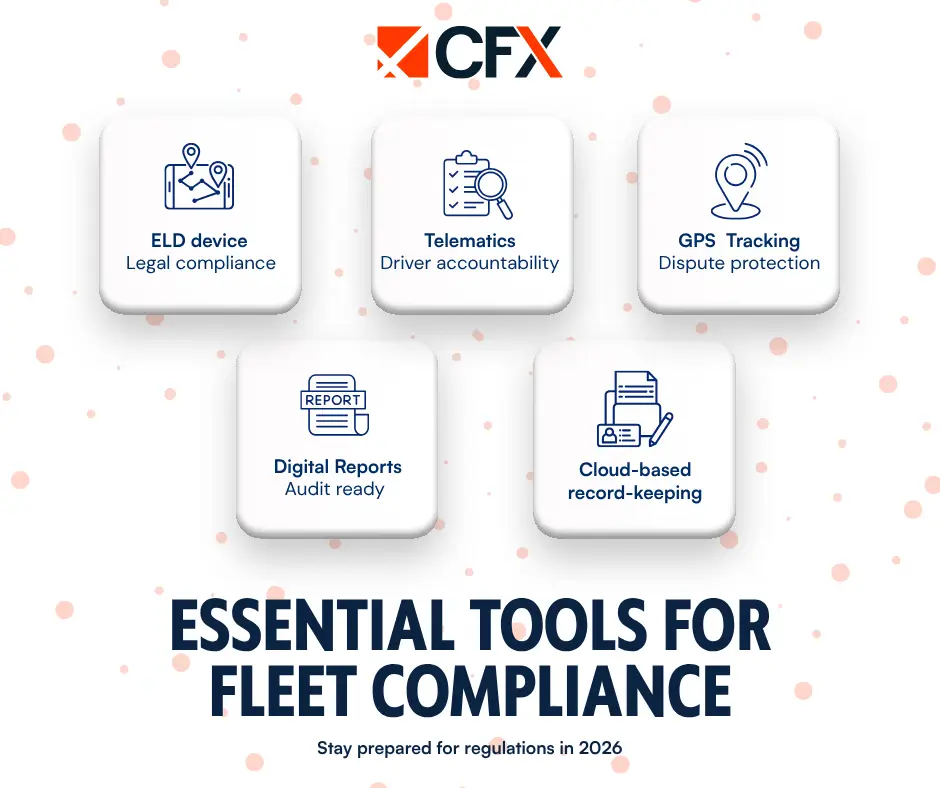
Beyond ELDs, the push toward full digital compliance is accelerating. Telematics platforms, GPS tracking, digital inspection reports, and cloud-based record-keeping are becoming the standard — not the exception.
What this means for small fleets:
The upfront cost is real. A compliant ELD setup costs $200 to $800 per truck, depending on the provider. It also has monthly subscription fees. For a 5-truck fleet, that's a line item you can't ignore.
But the cost of non-compliance is higher. A single roadside inspection violation can result in fines of $1,000 to $16,000 per offense under FMCSA guidelines. An out-of-service order shuts your truck down until it's corrected — and that lost revenue is gone forever.
What to look for in an ELD provider:
- FMCSA-registered and compliant
- Simple driver interface — the easier it is to use, the fewer errors you'll have
- Cloud syncing so you can pull records remotely
- Integration with your dispatch or TMS software if possible
- Reliable customer support — because breakdowns don't happen during business hours
Common ELD compliance mistakes small fleets make:
- Using an ELD that's been removed from the FMCSA registered list (this happens — check annually)
- Drivers not completing pre-trip and post-trip DVIR inspections in the system
- Not keeping 6 months of ELD records accessible for roadside inspections
- Assuming the device is working correctly without periodic audits
3. Hours of Service Rules — What They Mean for Your Schedule
Hours of service regulations exist for one reason: a tired driver behind an 80,000-pound truck is one of the most dangerous things on any road in America. The federal limits are designed to prevent fatigue-related accidents — and the enforcement has only gotten tighter.
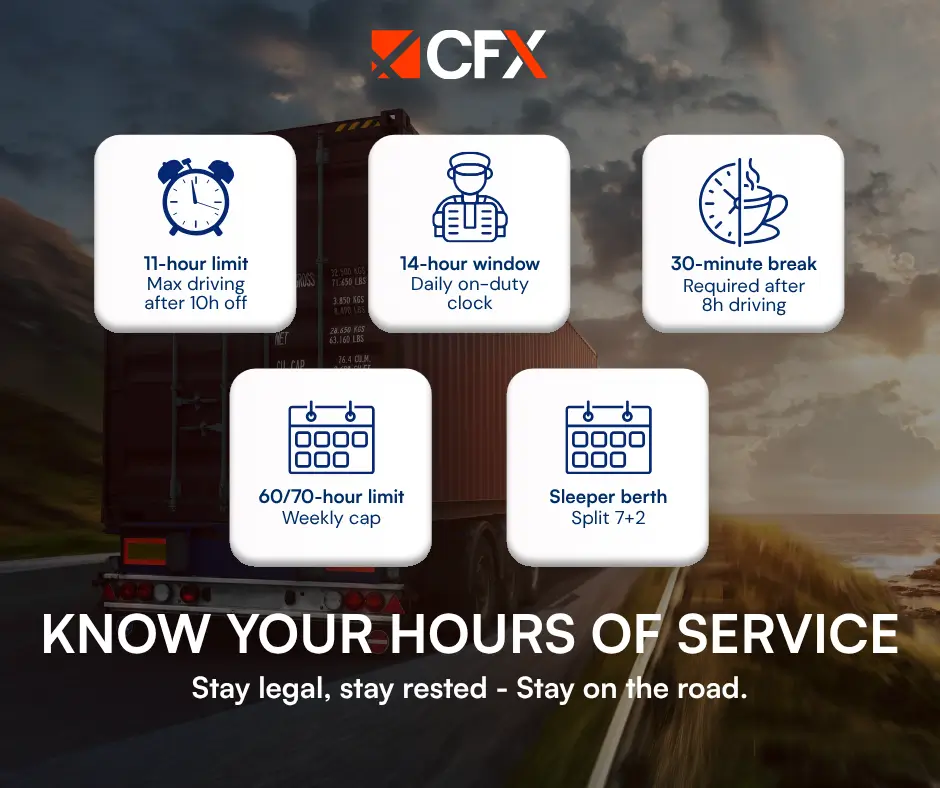
The current HOS rules every small fleet operator needs to know:
11-hour driving limit — A driver may drive a maximum of 11 hours after 10 consecutive hours off duty.
14-hour window — A driver cannot drive after the 14th straight hour on duty. This applies after 10 straight hours off duty. Off-duty time does not extend the 14-hour window.
30-minute break requirement — Drivers must take a 30-minute break after 8 cumulative hours of driving without at least a 30-minute interruption.
60/70-hour limit — Drivers may not drive after 60 hours on duty in 7 consecutive days, or 70 hours in 8 consecutive days.
Sleeper berth provision — Drivers using a sleeper berth may split their required 10-hour off-duty period into two periods — one of at least 7 consecutive hours and one of at least 2 hours.
Short-haul exemption — Drivers operating within a 150 air-mile radius who return to their work reporting location within 14 hours may be exempt from ELD requirements and the 30-minute break rule.
What this actually costs small fleets:
The scheduling impact is where most small operators feel HOS rules the hardest. A load that looks profitable on paper stops looking that way when a driver hits their 14-hour window 40 miles from the delivery and has to sit until the clock resets.
Traffic delays, loading issues, and appointment windows that don't account for drive time create cascading problems — one delayed delivery pushes the next appointment, which pushes the next dispatch, which costs you another load. For a 5-truck fleet, one mismanaged HOS situation can ripple through the whole week.
Practical fixes:
- Build HOS margin into every dispatch — if a load technically fits in 10 hours, plan for 12
- Use your ELD's HOS dashboard daily, not just when a driver gets stopped
- Pre-plan routes that account for realistic traffic, not just map distance
- Communicate appointment flexibility with brokers and shippers upfront — not after the driver is stuck on the road
4. Safety Standards, CSA Scores, and Why Your Insurance Depends on It
The FMCSA's Compliance, Safety, Accountability (CSA) program scores every carrier based on safety performance data collected from roadside inspections, crash reports, and investigation results.
Your CSA score isn't just a number on a government website. It directly affects your ability to get loads, your insurance premiums, and in serious cases, your operating authority.
The 7 BASIC categories CSA tracks:
- Unsafe driving
- Hours of service compliance
- Driver fitness
- Controlled substances and alcohol
- Vehicle maintenance
- Hazardous materials compliance
- Crash indicator
Each category has a threshold. Exceed it, and you get flagged. Get flagged enough, and the FMCSA initiates an investigation. For small fleets, a single serious incident can push you over a threshold and trigger scrutiny that takes months to recover from.
Why maintenance is the biggest risk for small fleets:
Vehicle maintenance violations are the most common source of CSA points for small carriers. Brakes, tires, lights, coupling devices — these are the items inspectors go straight to. A failed brake adjustment on one truck can generate enough points to affect your entire safety rating.
The brutal math: a brake violation discovered at roadside costs you an out-of-service order and CSA points. The same brake issue caught in your own shop costs you $200 and an hour of downtime. Preventive maintenance isn't optional at this level — it's the cheapest compliance strategy you have.
What high CSA scores actually cost you:
Insurance carriers watch CSA scores closely. A carrier with high scores in several BASIC categories may see insurance premiums rise 15% to 40%. For a five-truck fleet paying $50,000 a year for insurance, that is $7,500 to $20,000 in extra yearly costs. These costs come directly from preventable violations.
Some brokers and shippers also run CSA checks before awarding loads. A poor safety record can quietly disqualify you from freight opportunities without anyone telling you why.
5. Environmental Regulations and What They Mean for Your Next Truck Purchase
Environmental compliance is no longer a California problem. Emissions standards are tightening across the country. Small fleets must plan for them now. Do not wait until a truck fails an emissions test in a state where they operate.
What's driving the change:
EPA emissions standards for heavy-duty trucks have been progressively tightening. The EPA's Phase 3 greenhouse gas standards for heavy-duty vehicles finalize requirements through 2032, pushing manufacturers toward lower-emission powertrains.
For small fleet operators, the practical impact shows up in two places: the trucks you can buy and the routes you can run.
Older trucks and restricted zones:
Several major metro areas — Los Angeles, New York, Chicago — have or are developing low-emission zones that restrict older, higher-emission trucks from operating. If your lanes run through these corridors, your 2012 model year truck may face operational restrictions within the next few years.
The cost of compliance:
Replacing one Class 8 truck runs $150,000 to $200,000 new, or $80,000 to $120,000 for a compliant used truck. For a small fleet, that's not a line item — that's a financing decision that affects your cash flow for years.
What small fleet operators should do now:
- Know the model year and emissions tier of every truck in your fleet
- Research the emissions requirements for your primary operating states
- Factor compliance costs into your equipment replacement timeline — don't wait until a truck fails
- Explore whether newer, cleaner trucks qualify for any state or federal incentive programs before you buy
6. Driver Recruitment and Retention Under New Compliance Rules
The driver shortage isn't new. But new compliance requirements are making it harder in ways that don't always get talked about.
Every additional compliance layer adds friction to the hiring process. Drug and alcohol clearinghouse checks, new entrant safety audits, medical certification requirements — each one adds time and paperwork between "we want to hire you" and "you're on a load."
For small fleets competing against larger carriers who can offer sign-on bonuses, better benefits, and more predictable home time, that friction matters. A driver who has three offers on the table isn't waiting two weeks for your onboarding process to clear.
What actually retains drivers in 2025:
Pay matters — obviously. But the carriers with the best retention numbers in the small fleet category aren't always the ones paying the most. They're the ones running the tightest operations.
Drivers want to know when they're getting paid. They want equipment that doesn't break down on a Friday night in a state where you don't have a maintenance relationship. They want a dispatcher who answers the phone and has the next load ready before the current one is delivered.
They also want to get paid fast. In an industry where pay periods can stretch to weekly or bi-weekly cycles, carriers offering instant pay options — like the kind CFX enables through TANK Payments — have a real recruiting and retention advantage. A driver who knows they can get paid the same night they deliver a load isn't as tempted by a competitor's $0.02/mile rate difference.
Compliance-specific retention issues:
- Drivers who feel monitored and micromanaged by ELD systems leave faster. Use your telematics data for coaching, not just enforcement.
- HOS restrictions that create unrealistic schedules burn drivers out. Build schedules that keep drivers legal and rested — not schedules that technically comply but leave no margin.
- Drivers who get cited at roadside for equipment issues that should have been caught by the carrier lose trust fast. Your maintenance record is their reputation at the scale.
7. The Real Cost of Compliance for a Small Fleet
Let's put actual numbers on what full compliance costs a 5-truck fleet annually:
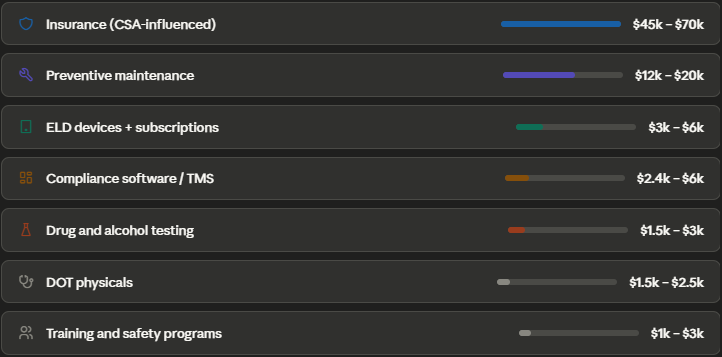
The bottom line: compliance costs money whether you manage it or not. The carriers who manage it proactively spend $45k less per year than the ones who react to problems after they happen.
That's a wide range — and where you land depends almost entirely on how proactively you manage it. Carriers who catch violations before they become fines, who maintain equipment before it fails, and who train drivers before an incident happens consistently land at the lower end of that range.
Carriers who react instead of plan land at the top — or higher, once you add fines, out-of-service costs, and insurance rate increases.
8. How to Stay Compliant Without a Dedicated Compliance Team
Most small fleet operators aren't going to hire a compliance director. But there are practical systems you can put in place that keep you covered without adding a full-time salary to your overhead.
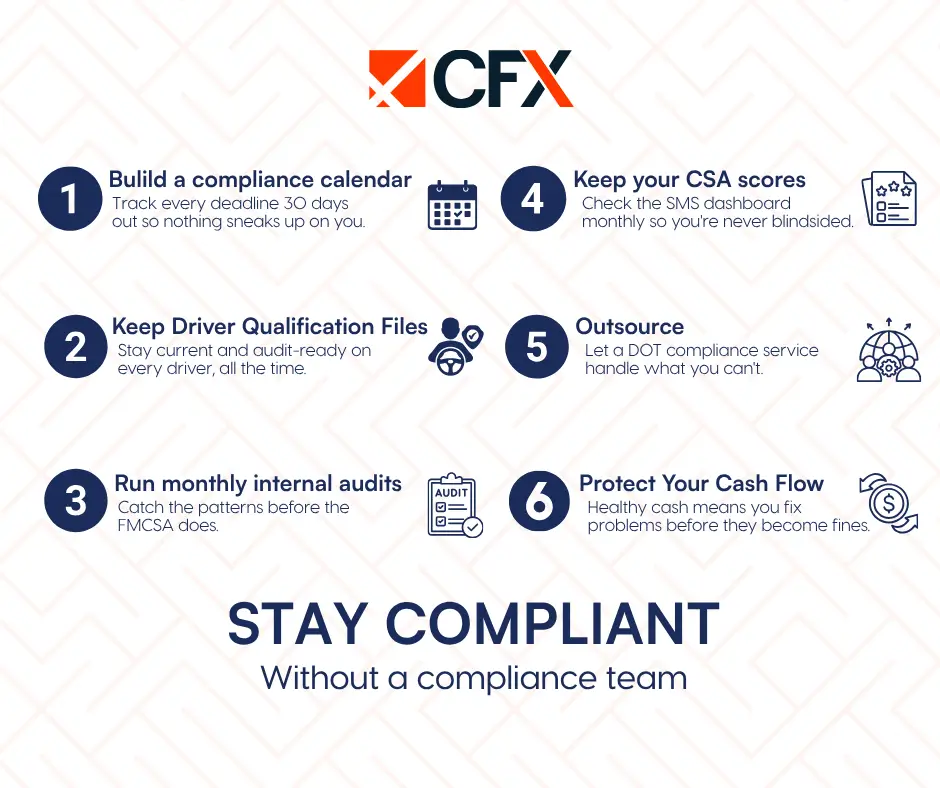
Build a compliance calendar: Every recurring requirement — DOT physicals, MVR checks, vehicle inspections, drug testing — goes on a calendar with reminders 30 days out. Missing a deadline because you forgot it was coming is the most expensive kind of compliance failure.
Use a driver qualification file system: Every driver needs a DQ file. CDL copy, medical certificate, MVR, drug test results, employment application, road test certificate. Keep them current and accessible. An audit that catches a missing document is a correctable problem. An audit that finds you never had the document is a much bigger one.
Run monthly internal audits: Pick one day a month. Pull every truck's maintenance log. Check every driver's HOS records for the past 30 days. Look for patterns — the same driver consistently cutting close on hours, the same truck generating recurring maintenance write-ups. Catch the pattern before the FMCSA does.
Know your CSA scores: Log into the FMCSA's Safety Measurement System monthly. Know where you stand in each BASIC category before an inspector does. If you're approaching a threshold, you have time to course-correct. If you're already over one and didn't know it, you're already behind.
Get help where it makes sense: There are DOT compliance services specifically built for small fleets — outsourced compliance management that handles DQ files, random drug testing pools, audit prep, and regulatory updates for a flat monthly fee. For most 5-truck operations, it's significantly cheaper than the first fine it prevents.
Protect your cash flow so compliance costs don't break you: Carriers who fall behind on compliance the fastest are often short on cash. When money is tight, the preventive maintenance gets deferred. The new ELD subscription gets canceled. The training program gets skipped. And then the violations start stacking up.
Keeping your cash flow healthy is part of your compliance strategy. This includes instant funding, clean factoring, and tight financial management. You may not think of it that way, but it is. A carrier with money in the account can fix the brake issue when it shows up. A carrier waiting on a wire from Friday can't.
9. FAQs
What are the most important trucking regulations for small fleets in 2025? The highest-impact regulations for small fleets currently are ELD compliance, hours of service rules, CSA safety scoring, and state-level emissions standards. These four areas generate the most violations, the highest fines, and the most operational disruption for carriers running under 10 trucks.
How does the CSA scoring system affect small trucking companies? CSA scores directly impact insurance premiums, broker relationships, and FMCSA oversight. Small fleets are more vulnerable to score fluctuations because a single violation affects a smaller total inspection count, creating bigger percentage swings. A violation that barely moves the needle for a 50-truck carrier can push a 5-truck carrier over a BASIC threshold.
What is the ELD mandate and who does it apply to? The ELD mandate requires most commercial motor vehicles subject to HOS regulations to use a registered electronic logging device instead of paper logs. Exemptions include drivers operating under the short-haul exemption, drivers of vehicles older than model year 2000, and certain agricultural and construction operations. Check the FMCSA's exemption list if you think your operation may qualify.
How much do trucking regulations cost small fleets per year? Full compliance for a 5-truck fleet typically runs $67,000 to $111,000 annually when you include ELD subscriptions, testing programs, preventive maintenance, insurance, and compliance software. The actual number depends heavily on how proactive your maintenance and safety programs are.
How can small fleets compete with large carriers on compliance? By being more agile. Large carriers move slowly — policy changes, system updates, and training rollouts take months. A small fleet operator can update a procedure, retrain a driver, and fix a system gap in days. The advantage of being small is speed. Use it.
What happens if a small fleet fails a DOT audit? Depending on the severity of the findings, a failed DOT audit can result in a conditional or unsatisfactory safety rating, civil penalties, required corrective action plans, and in serious cases, a notice to shut down operations. A conditional rating requires documented corrective action within a set timeframe. The most important thing is to not ignore it — unresolved findings escalate quickly.
Is there financial help available for small fleets trying to meet emissions standards? Yes — several states offer incentive programs, vouchers, or low-interest financing for small carriers upgrading to cleaner equipment. The California HVIP program is the most established, but similar programs exist in other states. The EPA's SmartWay program also offers resources and recognition for carriers improving fuel efficiency and emissions performance.
Running a compliant, profitable small fleet means keeping your trucks moving and your cash flowing. CFX offers instant funding through TANK Payments — so compliance costs, maintenance bills, and driver pay never have to wait on a wire. Talk to CFX today.