There is a way to make money in freight that needs no trucks, no drivers and no insurance.
It runs like this. Someone holding an authority and no equipment takes a load from a legitimate broker, posts it again at a lower rate, and lets a real carrier haul it. The broker pays them on delivery. The carrier invoices and hears nothing back. By the time anyone traces the chain, that authority has gone quiet and reappeared under another name. The margin was whatever the carrier was owed.
That is double brokering. The carrier it happened to usually works it out around day forty five, standing in a dispatch office with a signed BOL that nobody will honour.
What Is Double Brokering?
Double brokering in trucking is when a load changes hands after it has been assigned, without the shipper or the original broker agreeing to it.
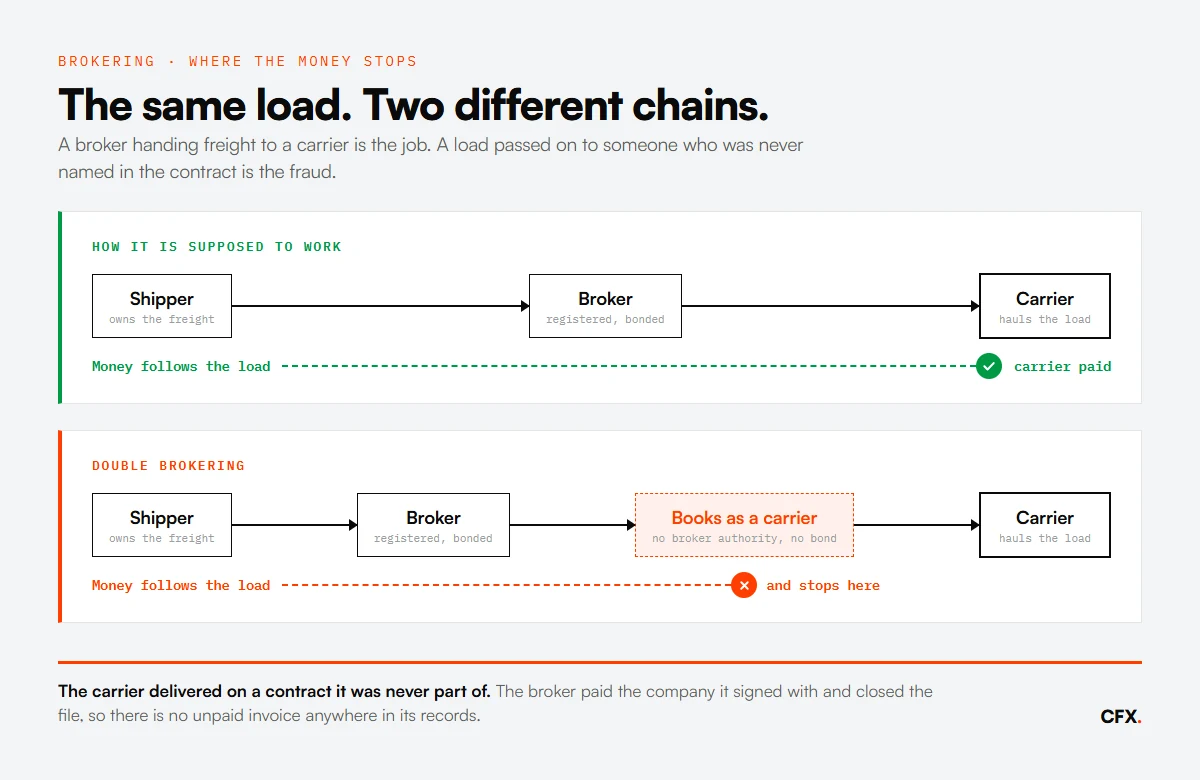
The chain runs like this. A shipper hands freight to a broker who is exactly who they say they are. Someone posing as a carrier books it. Rather than hauling, they re-post it and hire a carrier who has no idea there is an extra link in the chain. That carrier delivers. The original broker pays the company named on their contract, marks the load complete and closes the file. The money stops there.
What the hauling carrier is left with is an invoice addressed to a company that was never part of the agreement, and a contract they are not named in.
Double Brokering vs Co-Brokering
These two get confused constantly, and the difference has nothing to do with how many companies touch the load. It comes down to whether anyone was told.
Co-brokering is legal. Two brokers run a load together, everyone involved knows, and a written agreement covers who pays whom. It happens all the time when one broker holds the customer and the other holds the capacity.
Double brokering is not legal, though the reason is registration rather than secrecy, and the distinction is worth getting right.
Arranging for another carrier to haul a load, in exchange for compensation, is brokerage. Under 49 U.S.C. 14916 that may only be done by a party registered as a broker under section 13904 and carrying the financial security required by section 13906. Motor carrier authority does not include broker authority. They are separate registrations with separate requirements.
So the operator who accepts a load as a carrier and hands it to someone else is brokering. Holding no broker registration and no bond while doing it is the violation. The concealment is how the scheme runs, not what makes it unlawful.
Where a party genuinely does hold broker authority and a bond, passing the load on without telling the shipper or the original broker is normally a breach of the rate confirmation, which almost always prohibits re-brokering. That is a contract matter rather than a federal one, and the remedy for it is different.
A second broker named on the rate confirmation before the load is accepted is ordinary business. A second broker discovered six weeks later, while chasing a payment, is the version that leaves a carrier with no contract and often no solvent party to claim against.
Is Double Brokering Illegal?
Yes, and the statute is worth reading properly because of what it hands the carrier.
MAP-21 section 32919 created 49 U.S.C. 14916, "Unlawful Brokerage Activities". Brokerage services may be provided only by someone registered under section 13904 who has satisfied the financial security requirements of section 13906. Double brokering freight outside that registration is a violation of it.
Three things follow from the text, and the last two are the ones that rarely get mentioned.
A civil penalty of up to $10,000 for each violation, payable to the government.
A private cause of action. The statute makes a violator liable "to the injured party for all valid claims incurred without regard to amount". The carrier who hauled the load is the injured party, and that claim carries no cap.
Personal liability. It applies "jointly and severally" to the corporate entity and to "the individual officers, directors, and principals" of it. A shell company with no assets does not end the matter, because the people behind it are named in the statute itself.
Can You Go to Jail for Double Brokering?
Yes, but not under the brokerage statute, and the difference is the reason it happens so rarely.
Section 14916 carries civil penalties only. Nothing in it provides a custodial sentence, so an FMCSA action against a broker ends in a fine and a lost registration rather than a cell.
The prison route is wire fraud. A scheme run by email and phone to collect on freight the operator never intended to pay the hauling carrier for is fraud carried out by wire, and 18 U.S.C. 1343 provides for a fine or imprisonment "not more than 20 years", rising to 30 years where a financial institution is affected.
Those sentences are handed down. In May 2026 Aivaras Zigmantas was sentenced to 60 months in federal prison in the Northern District of Illinois after pleading guilty to wire fraud, having used aliases between 2020 and 2023 to present himself as a representative of carriers and brokers and divert more than $10.1 million in freight (U.S. Attorney's Office, Northern District of Illinois, 8 May 2026).
What that case also shows is the scale a federal prosecutor takes on. One stolen load does not reach a US Attorney. A ten million dollar operation does. For a carrier owed four thousand dollars, the criminal route is real but it is not a remedy.
What enforcement actually looks like
Illegal and enforced are not the same thing, and the gap is wide enough here to plan around.
FMCSA publishes its closed enforcement cases. Across the seven fiscal years from 2020 to 2026, the agency closed 13 enforcement cases against brokers, settling $116,634 in total. Over the same period it closed 18,108 cases against carriers, roughly 1,393 carrier cases for every broker case. Four of those seven years recorded no closed broker cases at all. (FMCSA Enforcement Management Information System, national summary of closed enforcement cases, data snapshot 2026-08-28. FY2026 is partial.)
Nobody is coming. The registration, the bond and the private claim are real and usable. Waiting for the agency to act on a specific broker is not a recovery plan, which is why the rest of this is about catching it before the trailer moves.
How to Spot a Double Brokered Load
Most of these loads carry the same fingerprints.
The MC number on the rate confirmation does not match the company in the email thread. Clearest signal there is, and it costs thirty seconds. Pull the authority up on FMCSA SAFER and compare legal name, MC number and address against the document.
The rate sits well above what the lane pays. Nobody overpays out of kindness. That extra margin exists because the invoice was never going to be settled. Our cost per mile calculator gives the floor a load has to clear, which makes a suspiciously generous rate easier to recognise.
Fast acceptance is demanded and phone calls are not returned. Pressure combined with email-only contact is worth stopping over.
Nobody at the pickup recognises the broker named on the paperwork. Asking at the dock who tendered the load takes one question. A mismatch there means do not load.
The authority is brand new. On its own this proves nothing, plenty of honest brokers opened last month. Alongside anything above, it matters.
A clean authority is not proof either, and this is the part that has changed. The newer version of freight fraud does not fake an identity, it buys one. On 29 September 2026 a Los Angeles jury convicted two men who had done exactly that. One of them paid about $22,000 for a Texas carrier called Z&F Transportation LLC in March 2024, then used it to take loads that were never delivered, and bought a second carrier two months later. The scheme ran until June 2025 and cost shippers at least $2 million (U.S. Attorney's Office, Central District of California, 29 September 2026).
That case was charged as cargo theft rather than double brokering, because the loads were stolen outright instead of hauled and left unpaid. The enabling trick is the same one. A purchased authority passes every check above. The MC number is real, the safety record is real, the history is real, because all of it belonged to a legitimate company until somebody wrote a cheque for it. What does not transfer with the paperwork is how the company pays, and payment behaviour is the one thing a broker credit check actually reads.
Remit-to details change after booking. A fresh payment address arriving by email once the load is already covered is a problem whether or not double brokering is involved.
When the Load Is Already Delivered
Recovery is harder than prevention, but there is an order that works.
Pull every document into one place. Rate confirmation, signed BOL, proof of delivery, the full email and text history, the load board posting if it still exists. A claim is worth exactly what the paper trail supports.
Go to the original broker, not the one who called. Finding out who actually tendered the freight usually reveals a company that was defrauded as well, and they hold the contractual relationship with the shipper.
File against the bond, and watch the clock. Where the hiring company holds genuine authority, a $75,000 surety bond or trust fund stands behind it under 49 CFR 387.307, and it exists specifically to pay motor carriers when a broker fails to carry out its arrangements. That $75,000 is split across everyone who claims, so timing counts.
The deadline is the part worth knowing. Once a surety reports a broker's financial failure, FMCSA publishes notice in the FMCSA Register and claims are accepted for 60 calendar days from that publication, under 49 CFR 387.307(f)(4). Miss the window and the bond is gone. Watch the FMCSA Register rather than waiting to be told.
Stop hauling for them. Another load offered while an invoice sits unpaid is not goodwill.
How to Report Double Brokering
Two places, and both are worth the time.
FMCSA National Consumer Complaint Database, at nccdb.fmcsa.dot.gov. The official channel, and complaints feed enforcement against the authority involved.
DOT Office of Inspector General hotline, for anything involving clear fraud.
The load board deserves a call too. They can pull the posting and suspend the account, which spares the next carrier while a federal complaint grinds forward.
Reporting rarely recovers the specific invoice. It is how an operator eventually loses the authority, and twenty minutes is a fair price for that.
Knowing the Broker Beforehand Costs Nothing
Everything above describes cleaning up after the fact, and cleaning up is expensive.
The cheap version is knowing a broker's payment history before the load is accepted rather than sixty days later. CFX runs a free credit check on the broker before any commitment, which turns a question about character into a question about record. That check comes with same day factoring and carries no charge.
The paperwork underneath all of this is worth understanding too. A Notice of Assignment instructs the broker to pay the factoring company rather than the carrier, which puts a documented line between that broker and a business whose entire job is tracking which brokers actually pay. Switching providers later means a Letter of Release to cancel the old one cleanly.
Run freight for brokers nobody has checked and the credit risk of every company on the dispatch sheet sits with the carrier. That is a heavy thing to carry for a load that already took two days.
Sources
- 49 U.S.C. 14916, Unlawful Brokerage Activities (Cornell LII, retrieved 2026-10-07). Added by MAP-21, Pub. L. 112-141, div. C, title II, section 32919(a), 6 July 2012. The registration requirement, the $10,000 civil penalty, the private claim "without regard to amount" and the joint and several liability of officers, directors and principals are all quoted from this text.
- 49 CFR 387.307, Property broker surety bond or trust fund (Cornell LII, retrieved 2026-10-07). The $75,000 amount, the purpose of the security, and the 60 calendar day claim window at paragraph (f)(4).
- 18 U.S.C. 1343, Fraud by wire, radio, or television (Cornell LII, retrieved 2026-10-07).
- U.S. Attorney's Office, Northern District of Illinois, 8 May 2026, the Zigmantas sentencing.
- U.S. Attorney's Office, Central District of California, 29 September 2026, the Z&F Transportation and Skyways Trucking verdict.
- FMCSA Analysis & Information Online, Summary of Closed Enforcement Cases. Figures from the FY2020 to FY2026 export, broker and motor carrier subjects, taken 2026-08-28. The report queries a live snapshot, so a later pull will return different totals.
- FMCSA National Consumer Complaint Database and the DOT Office of Inspector General Hotline. Broker bond failures are published in the FMCSA Licensing and Insurance Register at li-public.fmcsa.dot.gov.
Want the brokers checked before the next load is accepted? Talk to an Expert and we will look at who you are running for now.