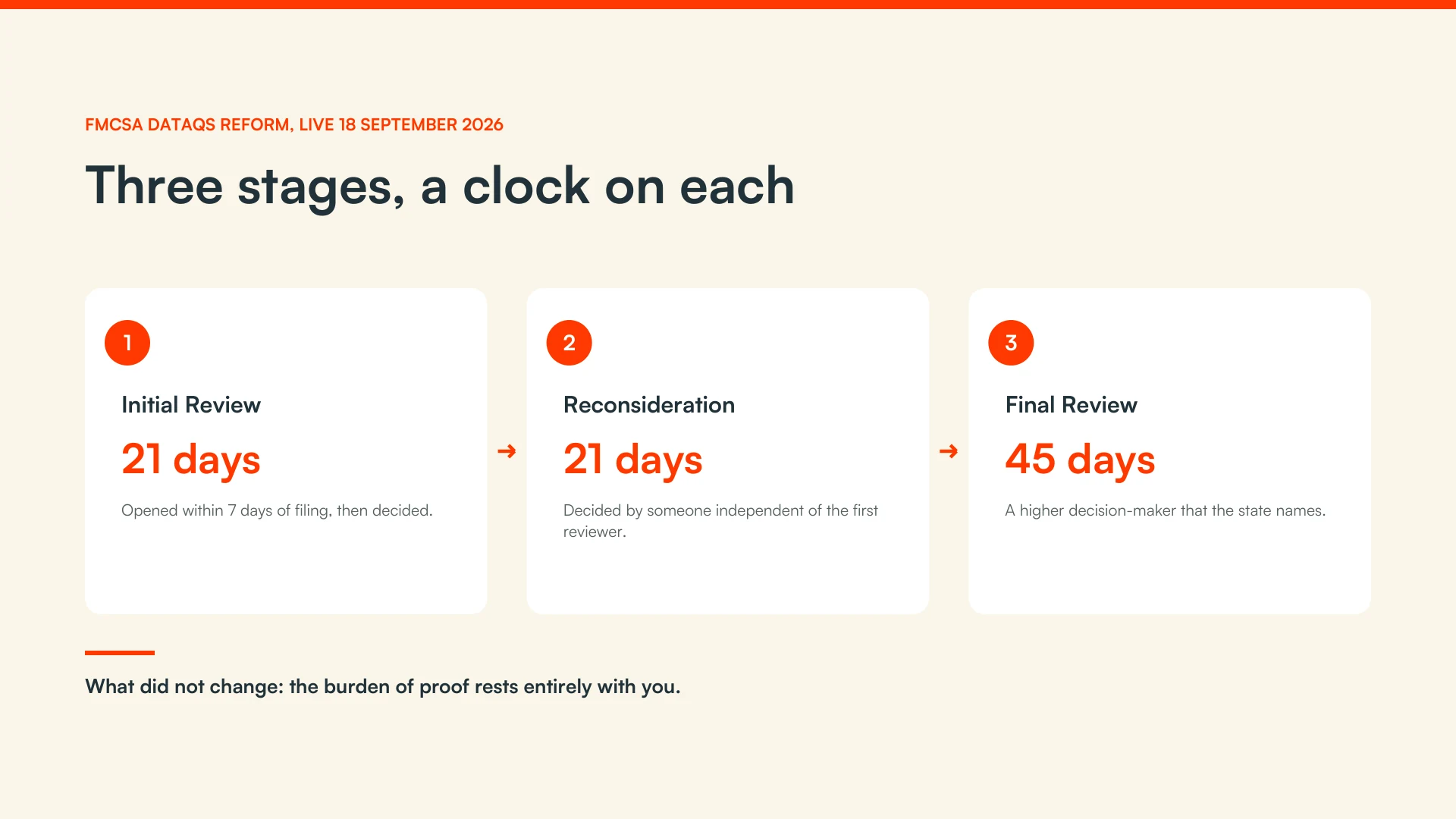
On 18 September 2026, FMCSA switched on a rebuilt DataQs process, and by 15 October every state and territory was operating under it (Overdrive, 15 October 2026).
If you have ever filed a challenge against a violation and had it closed with a one-line rejection and nowhere to go, that is the thing that changed. There are now three stages, a clock on each one, and a rule that a denial has to tell you why.
One thing did not change, and it is the part that decides whether you win.
What DataQs Is
DataQs is FMCSA's online system for challenging inspection records, crash reports and violations that you believe are incomplete or incorrect. You file what is called a Request for Data Review, or RDR, and a state agency reviews it. It is the only official channel for correcting safety data, and a correction there is the only thing that removes a violation from your CSA score before it ages out on its own.
The Four Things That Changed
Three stages instead of one. The process now runs Initial Review, then Reconsideration, then Final Review. Previously, a rejected request effectively ended the matter (AIST Safety Consulting, 25 September 2026).
The officer who wrote it cannot decide your appeal. FMCSA's language is direct: the Reconsideration "must not be reviewed or decided by the issuing officer or inspector", nor by that officer's immediate supervisor, and the reviewer must be "separate and independent from the person(s) who decided on the Initial Review". The Final Review goes higher still, to a decision-maker the state names, and nobody involved in the earlier decisions may touch it (FMCSA, Federal Register document 2026-07429, 16 April 2026).
A deadline on every stage. The state must open your request inside 7 days and decide the Initial Review inside 21. Reconsideration gets its own 21 days. Final Review has to be finished inside 45 (Trucksafe, 15 April 2026). Before this, a request could sit while the state worked through a backlog.
Denials must explain themselves. A decision closed as "Closed, No Data Correction Made" now has to "adequately explain the facts and analysis supporting the decision" and give specific reasons (FMCSA, Federal Register document 2026-07429). That matters because you cannot build a Reconsideration argument against a decision you do not understand.
States must also designate points of contact for inspection and crash requests, accept an RDR filed within three years of an inspection or five years of a crash, and submit implementation plans that FMCSA then publishes through DataQs. FMCSA has said it will publish state timeliness reports on the DataQs website once it has collected enough data, measured as percentages rather than as average review times (FMCSA, Federal Register document 2026-07429).
What the Reform Did Not Change
This is the part most coverage skipped.
The burden of proof stays entirely with you. FMCSA was explicit: for all DataQs requests, the burden "rests entirely with the requestor". More process does not mean a friendlier process. It means more opportunities to present evidence you still have to produce yourself. On an appeal you also have to address the state's earlier factual or legal basis and say why it was wrong, rather than restating your original filing (FMCSA, Federal Register document 2026-07429).
For context on what that means in practice, violation challenges are the least successful category of request, with about 39 percent resulting in a change (Trucksafe, 15 April 2026, citing FMCSA data).
The reform fixed the structural problem, which was that the system offered no real appeal and no accountability for slow or unexplained decisions. It did not lower the evidentiary bar. A challenge filed on the argument that the officer was wrong, with nothing attached, will fail in 2026 exactly as it failed in 2024.
How to File a Challenge That Actually Wins
Document before you need to. Photograph the tractor, trailer, plates, placards and any disputed component at the time of inspection. Keep the inspection report. Save ELD exports and maintenance records on a schedule, not when a problem appears. Evidence created after the fact is worth very little.
Know your window. Three years from an inspection, five years from a crash. Earlier is better, because witnesses, records and recollection all degrade.
File on facts, not interpretation. The strongest challenges show a factual error: the violation was recorded against the wrong USDOT number, the equipment cited was not on the vehicle, the maintenance record shows the repair predated the inspection, the ELD data contradicts the alleged hours violation. The weakest ones argue that the officer exercised bad judgment.
If you beat the ticket in court, file that too. This is a separate route and it is the most overlooked one. Where a citation was issued alongside the violation and you won in a due process system, FMCSA's adjudicated citations policy applies: a dismissal or a not guilty finding removes the violation, and a conviction on a different charge drops its severity weight to 1 with no out of service weight. It is not automatic. You have to submit certified documentation of the court result through DataQs, and it only covers inspections conducted on or after 23 August 2014 (FMCSA, SMS Methodology, BASIC Prioritization Status Version 3.21, June 2026).
Attach the evidence to the first filing. Do not hold material back for a later stage. The Initial Review is where most matters resolve, and a complete submission is what makes that happen.
Read the denial carefully, then escalate. The written explanation now required is a roadmap. It tells you which element of your argument failed, which is exactly what a Reconsideration request needs to address.
How This Reform Came Together
1 July 2025. FMCSA publishes "Proposed Revisions to DataQs Requirements for MCSAP Grant Funding" and opens public comment.
Late 2025. The docket draws 223 comments, 105 of them relevant to the proposal, from motor carriers, drivers, owner-operators, industry associations, safety consultants and the enforcement community.
16 April 2026. The final notice publishes in the Federal Register as document 2026-07429, running eight pages from 20561 to 20568. Compliance is tied to state eligibility for Motor Carrier Safety Assistance Program grants, which is the lever that made the reform stick. The requirements take effect 150 days after publication, with draft state plans due at 60 days and final plans at 120 (FMCSA, Federal Register document 2026-07429).
April to June 2026. FMCSA runs training and outreach for state agencies, and states submit their DataQs Implementation Plans showing how they will meet the requirements and clear existing backlogs (J.J. Keller, 16 April 2026).
18 September 2026. The reformed system goes live nationwide (J.J. Keller, 23 September 2026).
15 October 2026. All 50 states and the U.S. territories are reported to meet the new requirements (Overdrive, 15 October 2026).
Worth noting how this got done. FMCSA could not order states to change their procedures, so it tied compliance to MCSAP funding. Every state adopted the new process within six months.
What You Can Control While Enforcement Tightens
The reform arrived during a hard enforcement year. Operation Saturday Night Fever ran 552 inspections across South Carolina, North Carolina, Florida and Georgia, and placed 78 drivers and 25 vehicles out of service, with 12 of those drivers cited for failing English language proficiency requirements (SupplyChainBrain, 1 October 2026, on FMCSA's 30 September release).
That pressure is one reason capacity keeps tightening and rates keep holding. DAT's forecast has truckload contract rates rising 15 to 20 percent from January 2026 through the end of 2027 (Intelligent Audit, 5 October 2026, reporting DAT).
The carriers positioned to capture that are the ones who are both compliant and liquid. Compliance keeps the doors open. Liquidity is what lets you walk through them, because a better load next week does not help if your cash is sitting in an invoice a broker will pay in 45 days.
That is the part CFX handles. We check broker credit before advancing funds, so you know who you are hauling for, and we turn delivered invoices into working capital instead of a waiting game. Who carries the loss when a broker does not pay at all is a separate question, and it comes down to recourse against non-recourse. Factoring is the sale of an invoice you have already earned. It is not a loan, nothing is borrowed and nothing is repaid on a schedule, which is why the decision rests mainly on your customer's credit rather than yours.
If the paperwork is the constraint, the process above is where to start, and it costs you nothing but the hour it takes to assemble the evidence. If the cash is the constraint, what factoring costs is the other half of the arithmetic.
So which one is actually holding you back right now?
Frequently Asked Questions
What is DataQs? DataQs is FMCSA's online system for challenging inspection records, crash reports and violations you believe are incorrect or incomplete. The formal submission is called a Request for Data Review, or RDR, and a state agency decides it.
How long does a DataQs challenge take now? The state must open the request inside 7 days and decide the Initial Review inside 21. A Reconsideration gets a further 21 days, and a Final Review must be completed inside 45 (Trucksafe, 15 April 2026).
Can I appeal a DataQs decision? Yes, and this is new as of 18 September 2026. A rejected Initial Review can go to Reconsideration, and then to Final Review. Neither can be decided by the officer who issued the violation, that officer's immediate supervisor, or anyone who decided the earlier stage (FMCSA, Federal Register document 2026-07429).
How long do I have to file? Three years from the date of the inspection, five years from the date of a crash.
Does winning in court remove the violation? Not on its own. A dismissal or not guilty finding removes it and a conviction on a different charge drops the severity weight to 1, but only once you submit certified documentation of the court outcome through DataQs, and only for inspections conducted on or after 23 August 2014 (FMCSA, SMS Methodology, BASIC Prioritization Status Version 3.21, June 2026).
How often do violation challenges succeed? Violation challenges are the least successful category of DataQs request, with about 39 percent resulting in a change (Trucksafe, 15 April 2026, citing FMCSA data).
Sources
J.J. Keller, "DataQs improvements now in effect", 23 September 2026
J.J. Keller, "FMCSA updates the DataQs data correction system", 16 April 2026
Trucksafe, "FMCSA Finalizes DataQs System Overhaul with State Appeals Process", 15 April 2026
AIST Safety Consulting, "DataQs Gets New Rules: What Carriers Need to Know", 25 September 2026
Overdrive, "FMCSA's DataQs reforms officially in effect", 15 October 2026
CCJ, "What are FMCSA's new DataQ rules?"
SupplyChainBrain, "FMCSA Pulls 78 Truckers Out of Service in Multi-State Crackdown", 1 October 2026